
Scepter™ 3.0 Cell Counter by Merck: Fast, Accurate Handheld Cell Counting for Cell Culture Analysis
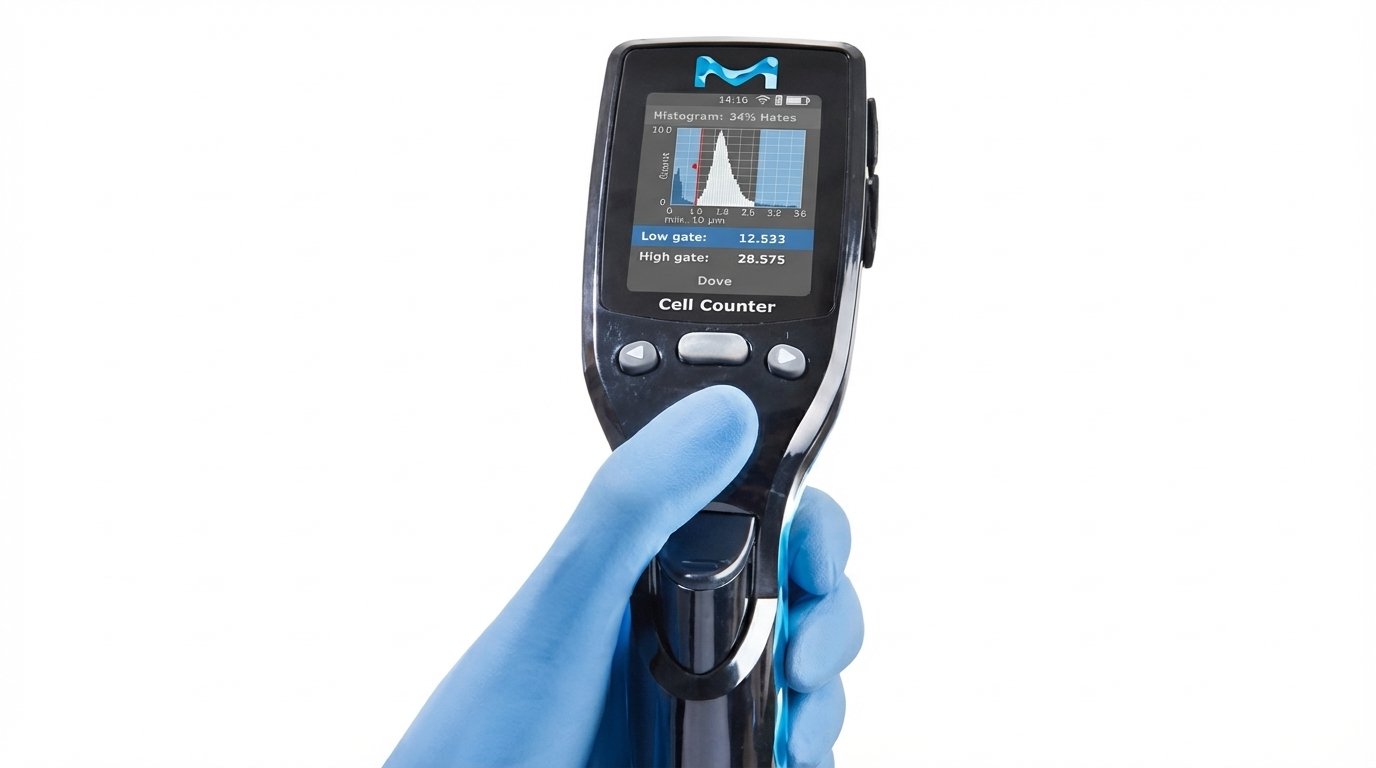
Reliable, fast cell counting is essential in cell culture and analysis, but traditional methods are time-consuming and imprecise. The Scepter™ 3.0 Cell Counter from Merck (Scepter 3.0 Cell Counter Merck) uses precision Coulter impedance technology in a portable, ergonomic device, delivering accurate counts in seconds. Explore how this innovation meets the industry’s needs and streamlines your cell counting workflow.
Benefits of Scepter™ 3.0 Cell Culture
- Fast turnaround for routine workflows: Delivers accurate, consistent cell counts in less than 30 seconds, helping you make passaging and seeding decisions quickly.
- Improved precision and reproducibility: Provides more precise counting than vision-based counting and hemocytometry, reducing reliance on subjectively determined results.
- More representative results per sample: Counts thousands of cells per sample, supporting confident decisions based on a larger measured population.
- Reliable counting for small cell types: Accurately counts particles as small as 4 μm in diameter and discriminates larger cells from smaller debris based on size.
- Confidence across diverse sample conditions: Demonstrates consistent data from diverse samples, including measurements performed in various cell culture buffers and reagents.
- Portability where you work: Brings cell counting directly to the culture hood with a handheld, portable format.
- Efficient data recording and reporting: Wireless transmission and USB transfer support reliable recording and archiving, plus straightforward comparison and reporting using common spreadsheet programs.
- Actionable culture insights beyond a single number: Displays cell populations as histograms of cell size or volume distributions and supports gating to count a chosen subpopulation for tracking culture status over time.
Features of Scepter™ 3.0 Cell Culture
- Instrument format: Handheld, portable automated cell counter.
- Counting technology: Coulter impedance counting technology (Coulter principle) for impedance-based cell detection.
- Non vision-based operation: Does not rely on vision-based technology, object recognition software, manual focusing, or hand-filled loading chambers.
- Sensor design: Microfabricated, precision-engineered microfluidic sensor with an embedded channel and a cell sensing zone.
- Sensor compatibility: Compatible with 40 µm and 60 µm Scepter™ sensors.
- Particle size ranges by sensor: 60 µm sensor for particles between 6 and 36 µm in diameter; 40 µm sensor for particles between 4 and 18 µm in diameter.
- On-device data visualization: Displays a histogram distribution of cell size or cell volume.
- Gating and histogram capacity: Instrument software can gate and capture up to 999 cell size or volume histograms, and supports creating and saving gating settings.
- Data export: Easily export data for in-depth analysis.
- Connectivity options: Wireless transmission of data to a printer or lab workstation; USB port for data access and transfer.
- Controls and display: Ergonomic placement of power and function buttons; larger, easier-to-read display.
- Storage and charging: Charger station with mountable storage and charging capability.
Technical Specifications of Scepter™ 3.0 Cell Culture
- Cell counting technology: Coulter impedance (Coulter principle).
- Sensor options: 40 μm sensor and 60 μm sensor.
- Particle diameter range, 40 μm sensor: 4 to 18 μm.
- Particle diameter range, 60 μm sensor: 6 to 36 μm.
- Minimum sample volume required: 100 μL.
- Sample volume measured per count: 50 μL.
- Operating cell concentration range, 60 μm sensor: 10,000 to 500,000 cells/mL.
- Counting time, 60 μm sensor: 14 seconds on average.
- Counting time, 40 μm sensor: within 25 seconds on average.
- Cells counted at 100,000 cells/mL: 5,000 (cells counted in a 100,000 cells/mL sample).
- Average %CV: 9.1.
- Histogram capacity: Gate and capture up to 999 cell size or volume histograms.
- Measured particle example: 8 μm polystyrene beads.
Application / Usage of Scepter™ 3.0 Cell Culture
- Routine cell counting for cell culture analysis: Use the handheld Scepter™ 3.0 Cell Counter to perform automated cell counts directly at the culture hood, with results delivered in less than 30 seconds.
- Sample preparation for counting: Prepare a single cell suspension and dilute to a total volume of 100 µL (minimum volume required for an accurate count) in phosphate buffered saline such as EmbryoMax® 1x DPBS, adjusting to 10,000 to 500,000 cells/mL (operating range for the 60 µm sensor) in a 1.5 mL microcentrifuge tube.
- Counting workflow (step-wise):
- Turn on the Scepter™ 3.0 cytometer by pressing the menu button on the instrument and follow the on-screen instructions.
- When prompted, attach an appropriate sensor to the end of the unit with the electrode sensing panel facing toward the front of the instrument.
- Press OK when prompted to begin drawing up sample, where 50 µL of cell suspension is drawn into the channel embedded in the sensor.
- The cell sensing zone detects each cell drawn through the sensor, calculates cell concentration, and records cell size and volume measurements.
- Generating cell size or volume distributions: Acquire histogram distributions of cell size or cell volume, count the full population, or use the gating function to count a chosen subpopulation (with instrument software supporting capture of up to 999 cell size or volume histograms, and creation and saving of gating settings).
- Monitoring cell culture health and status: Track changes in histogram distributions from one experiment to the next to gain insight into the health and status of a cell culture.
- Sensor selection for cell and particle sizing range:
- Use the 60 µm sensor for particles between 6 and 36 µm in diameter.
- Use the 40 µm sensor for particles between 4 and 18 µm in diameter (down to 4 µm when appropriate).
- Validated cell types and particles (examples from the provided tables): Validated by Millipore® scientists across a wide range of samples, including mammalian cell lines (e.g., Jurkat, HEK293, HeLa, CHO), primary and immune cells (e.g., PBMCs, mouse ES cells, mesenchymal stem cells, splenocytes, red blood cells, rat whole blood), and other models such as yeast (Pichia pastoris, S. cerevisiae), algae (various), polystyrene beads (8 µm), and Luminex® beads.
List of products under Scepter™ 3.0 Cell Counter from Merck
| Description | Quantity |
|---|---|
| Scepter™ 3.0 Handheld Automated Cell Counter | |
| Kit with 40 µm Scepter™ 3.0 Sensors (50 Pack) | 1 |
| Kit with 60 µm Scepter™ 3.0 Sensors (50 Pack) | 1 |
| Each Kit Includes: | |
| Scepter™ 3.0 Handheld Automated Cell Counter | |
| Scepter™ 3.0 Cell Counter Sensors (50 Pack) | |
| Scepter™ 3.0 Charger Station | |
| Scepter™ 3.0 Test Bead Vial | |
| Cell Counter Sensors & Accessories | |
| Scepter™ 3.0 Cell Counter Sensors, 60 µm | 50/pk |
| Scepter™ 3.0 Cell Counter Sensors, 60 µm | 250 (5 x 50/pk) |
| Scepter™ 3.0 Cell Counter Sensors, 40 µm | 50/pk |
| Scepter™ 3.0 Cell Counter Sensors, 40 µm | 250 (5 x 50/pk) |
| Scepter™ 3.0 Charger Station | 1 ea |
| Scepter™ 3.0 Charger Mounting Kit | 1 ea |
| Scepter™ 3.0 Test Bead Vial | 1 ea |
With over 23 years of expertise, Chemical Express is the official distributor of Merck in Thailand for solutions such as the Scepter 3.0 Cell Counter Merck and related accessories. Access the Scepter™ 3.0 Cell Counter and other original Merck and MilliporeSigma products for your laboratory through Chemical Express. Discover a complete selection of cell counting and analysis solutions from trusted brands.
Have questions about the Scepter™ 3.0 Cell Counter or ready to order?
Simply fill out our Inquiry Form or chat with us instantly on Line using the buttons below.
We’re here to help!
 English
 Thai