
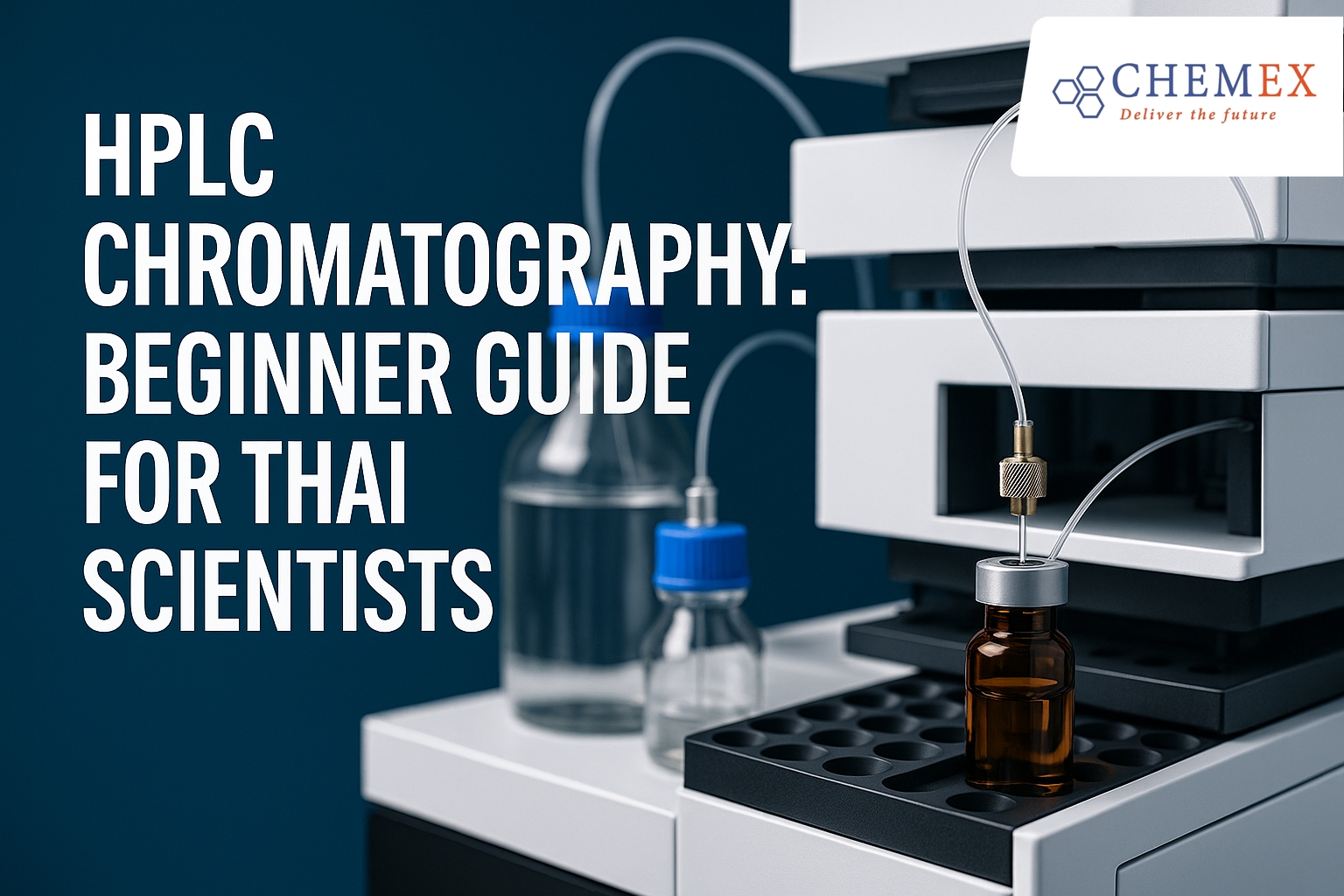
HPLC Chromatography: Beginner Guide for Thai Scientists
You need reliable separation data this week, but setting up HPLC from columns to mobile phases can feel like guesswork, especially under tight Thai lab timelines. Too many variables, too little time to test each one. This hplc chromatography beginner guide gives you field-tested starting conditions, a clear component checklist, and product picks you can source locally through Chemical Express Thailand.
What is HPLC and why do Thai labs choose it?
An hplc chromatography beginner guide starts with this core idea: HPLC, high performance liquid chromatography, separates analytes by differential interactions between a packed stationary phase and a pumped mobile phase. Each compound exits the column at a characteristic retention time, and the detector records a quantitative peak. The area or height of that peak ties directly to concentration.
Thai labs apply HPLC across food safety, pharmaceutical QC, clinical testing, and environmental monitoring. Common targets include APIs and impurities in tablets, vitamins in fortified drinks, pesticide residues in produce, and contaminants in water samples. Both assay and purity workflows rely on the same instrument.
HPLC wins over open-column liquid chromatography on speed and reproducibility. Autosamplers remove injection variability. UV and mass spectrometer detectors cover most analyte classes. When TLC resolution is too poor to quantify, or when analytes are non-volatile and GC is off the table, HPLC is typically the default choice.
How HPLC works in practice
The flow path is straightforward. Degassed mobile phase is pulled from a solvent reservoir and pushed by a high-pressure pump through a sample injector, into the column, past the detector, and to waste. An analyte plug injected onto the column partitions between the mobile phase and the stationary phase. Compounds with stronger affinity for the stationary phase elute later. The detector records the signal over time, and software integrates each peak.
Isocratic runs hold solvent composition constant throughout the run. They work well for simple matrices and narrow polarity ranges. Gradient runs ramp the organic content progressively, pulling out compounds across a wide polarity range faster than any single isocratic condition could manage.
Detection choices shape sensitivity and selectivity. UV at 210 to 220 nm captures most organics with carbonyls or conjugation. A 254 nm wavelength targets aromatics cleanly. Fluorescence detection improves sensitivity by one to three orders of magnitude for fluorescent compounds. LC-MS adds structural confirmation when co-eluting interferences make UV results ambiguous.
Column selectivity is the single largest lever on separation quality. Gradient design and oven temperature then fine-tune resolution and total runtime. Readers who want a deeper grounding in how LC and HPLC differ technically can find that context in our article on Liquid Chromatography (LC) vs HPLC: Key Differences, Principles, and Applications.
Key components and a starter setup for day one
The minimal HPLC stack is: a binary or quaternary pump, a manual injector or autosampler, a column with a guard cartridge, a column oven, a UV detector, and a chromatography data system for integration. Every component matters. A cheap guard column saves an expensive analytical column from particulate fouling.
For small-molecule work, a C18 column, 4.6 mm ID, 150 mm length, 5 µm particles is the most practical starting point. Set flow to 1.0 mL per min, oven to 30 °C, and detector to 254 nm or 220 nm depending on your analyte's chromophores. This combination covers a wide range of pharmaceutical and food analytes without specialised method development.
Supelco HPLC Columns from Merck, available through Chemical Express Thailand, map directly onto this starter specification. Thai QC labs running pharmacopoeial methods routinely use these columns because they cut column screening time and slot into existing SOPs without re-validation.
The table below summarises practical starter parameters and typical operating ranges.
| Parameter | Starter Value | Typical Range |
|---|---|---|
| Column dimensions | 150 mm x 4.6 mm | 50 to 250 mm x 2.1 to 4.6 mm |
| Particle size | 5 µm | 1.7 to 10 µm |
| Pore size | 100 Å | 60 to 300 Å |
| Flow rate (4.6 mm ID) | 1.0 mL/min | 0.5 to 2.0 mL/min |
| Flow rate (2.1 mm ID) | 0.3 mL/min | 0.1 to 0.6 mL/min |
| Injection volume (4.6 mm ID) | 10 to 20 µL | 1 to 100 µL |
| Injection volume (2.1 mm ID) | 1 to 5 µL | 0.5 to 20 µL |
| Detector wavelength (general) | 220 nm | 210 to 280 nm |
| Detector wavelength (aromatics) | 254 nm | 250 to 280 nm |
| RP starting solvent | Water / Acetonitrile (60:40) | Adjust organic 5 to 95% |
| HILIC starting solvent | Acetonitrile / Water (90:10) | 70 to 97% organic |
For teams setting up their first HPLC system, a useful comparison between LC and HPLC hardware and operating principles is available in our article: Liquid Chromatography (LC) คืออะไร? ต่างจาก HPLC อย่างไร.
Starter setup checklist
Before the first injection: plumb and prime all solvent lines, confirm no leaks at fittings, verify solvent miscibility and that buffer salts dissolve completely. Set oven temperature, equilibrate the column, then run a blank injection followed by a system suitability standard.
Document the baseline pressure at starting conditions. Any pressure rise above 20 percent of baseline during a run points to particulate fouling or phase collapse.
Quick tips for day one
- Always use a guard column. Replace it before the analytical column pressure climbs.
- Filter all samples through a 0.2 µm PTFE or nylon syringe filter before injection.
- Use HPLC-grade or UHPLC-grade solvents with low UV cutoffs to avoid absorbance-driven baseline rise.
- Scout gradients in isocratic mode at 30%, 50%, and 70% organic to bracket retention before committing to a full gradient.
- Log system pressure at each run. A rising trend over days signals column fouling early.
- Flush salts from the column with at least 10 column volumes of water before switching to high-organic storage solvent (typically 50% methanol or acetonitrile for RP columns).
- Cap column ports when idle to prevent stationary phase from drying out.
Applications and fast method choices for Thai labs
Common application snapshots
Paracetamol assay in tablets is the classic RP C18 exercise: water with 0.1% phosphoric acid and acetonitrile, UV at 243 nm, isocratic run under 10 minutes. Vitamin analysis in fortified drinks uses similar C18 conditions but typically requires a gradient to resolve fat-soluble and water-soluble vitamins in one run.
Pesticide screening in produce generally needs a gradient from 20 to 95% acetonitrile over 15 minutes on a C18 column, with LC-MS confirmation for regulatory submissions. Residual solvent checks in pharmaceutical ingredients are typically better handled by headspace GC when analyte volatility allows, leaving HPLC for the non-volatile impurity profile.
Matching mode to analyte chemistry
Beginners often over-complicate method selection. Start by classifying the analyte: non-polar to moderately polar neutrals belong on reverse phase C18 or C8. Polar, hydrophilic compounds (sugars, amino acids, nucleotides) perform better in HILIC. Ionic analytes (organic acids, quaternary amines) need ion-exchange or ion-pair RP.
Once you pick the mode, adjust gradient slope, buffer pH, and temperature to fine-tune peak shape and runtime.
Which separation mode fits your analyte?
- Non-polar to moderately polar small molecules
- APIs, vitamins, pesticides, phenolics
- Mobile phase: water + acetonitrile or methanol, with 0.1% acid modifier
- UV or MS detection; low-UV solvents required
- Polar, hydrophilic compounds poorly retained on C18
- Amino acids, sugars, nucleotides, polar metabolites
- Mobile phase: high acetonitrile (70 to 95%) + aqueous buffer
- Often paired with MS; good for food and clinical samples
- Strongly ionic analytes at working pH
- Organic acids, inorganic ions, charged biomolecules
- Mobile phase: aqueous buffer, salt gradient
- UV or conductivity detection; not MS-compatible without desalting
Solvent quality directly affects baseline stability in all three modes. TCI HPLC/UHPLC Solvents carry low UV cutoffs and low particulate levels, which keeps baseline drift low in gradient runs and reduces false peaks that waste troubleshooting time.
If you are unsure whether HPLC is even the right technique for your analyte class, the article When Should You Use Chromatography? Choosing the Right Technique walks through the selection logic clearly.
If you run TLC as a pre-screen to scout retention before investing in HPLC method development, reviewing how to calculate and interpret Rf values first will speed that scouting step. See: คำนวณค่า Rf ใน Chromatography อย่างไร?
Gradient scouting, small injection volumes (5 to 10 µL to start), and thorough sample clean-up through protein precipitation or solid-phase extraction consistently save more time than adjusting column chemistry after a failed run.
Key takeaways from this hplc chromatography beginner guide
Start with a proven C18 setup, use HPLC-grade solvents, choose your separation mode based on analyte polarity and charge, and document every condition from day one. Reproducibility is easier to build when starting conditions are written down before the first injection rather than reconstructed after a failed repeat.
HPLC Buffers from Merck and HPLC/UHPLC Solvents from TCI, both available through Chemical Express Thailand, support stable baselines and clean method transfer across instruments. Pairing correct reagent grade with a calibrated starter setup removes two of the most common sources of baseline instability in new labs.
You can move from zero to a defensible HPLC method by combining a C18 column, good solvent and buffer practice, disciplined equilibration, and systematic gradient scouting. Use the checklist and parameter table in this guide to standardise runs, cut troubleshooting time, and keep your Thai lab workflow on schedule.
Frequently asked questions
Recommended Products
All products below are available through Chemical Express Thailand. Submit an inquiry for pricing, availability, or technical guidance.
Recommended Products Available at Chemical Express
We deliver a wide range of Liquid Chromatography (LC/HPLC) products from Merck and TCI and other international brands across Thailand. For any inquiry or purchase, fill out our Inquiry Form or chat with us instantly on Line.
 English
 Thai