
Chemical Storage Compatibility: Which Chemicals Cannot Be Stored Together and Why
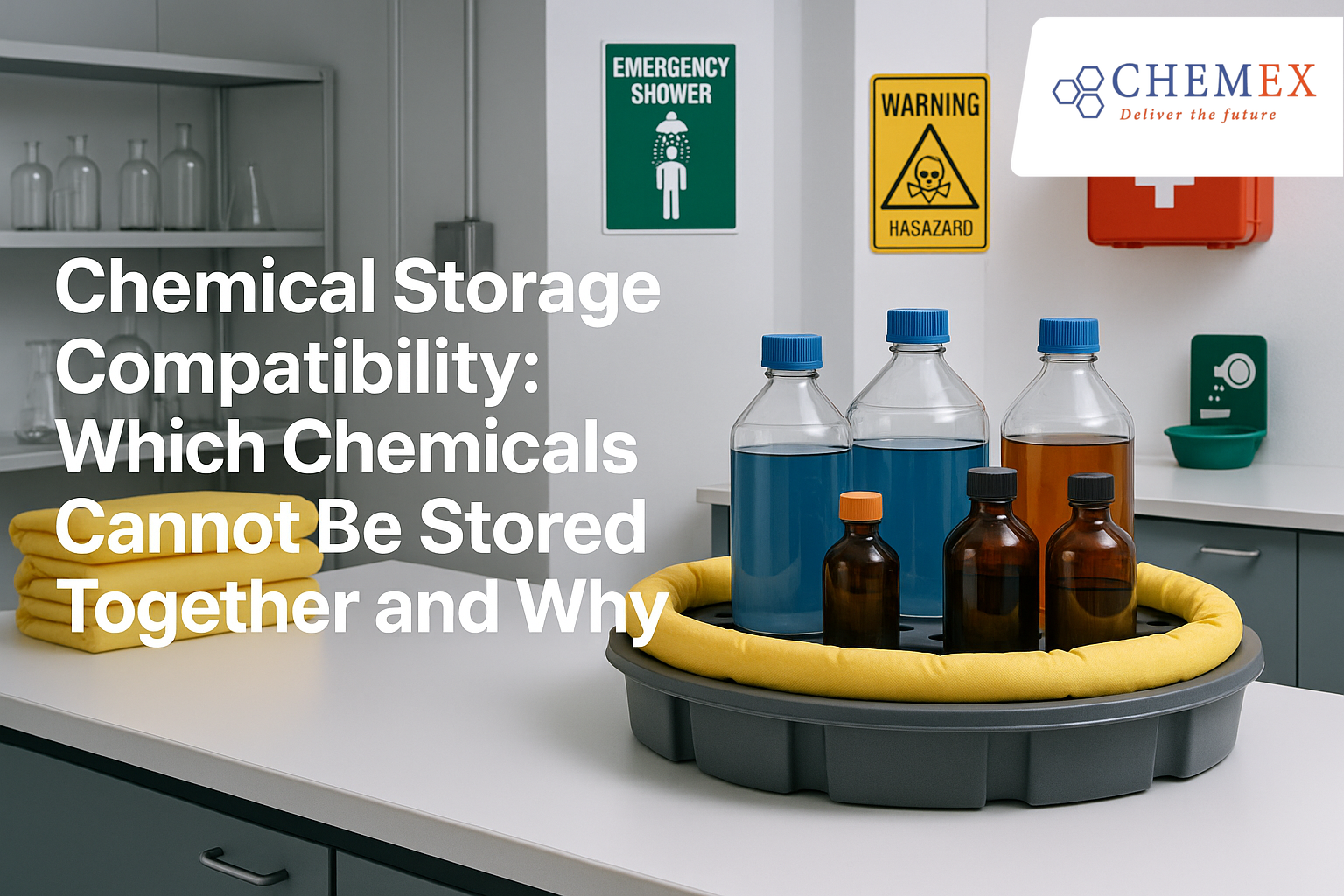
Storing the wrong chemicals next to each other is one of the most common causes of preventable laboratory incidents. A well-built chemical storage compatibility table helps you make smarter decisions before chemicals ever reach the shelf. This guide explains how incompatibilities create real hazards, how to build and use a compatibility table in practice, and what Thailand's regulatory landscape expects from facilities managing hazardous chemicals.
Chemical storage compatibility at a glance
Keeping incompatible chemicals apart prevents dangerous reactions before they start. Use this summary to orient your storage planning.
- Start with hazard classification. Group chemicals by their hazard characteristics, such as flammable, oxidising, corrosive, or toxic, as the foundation of your compatibility table.
- Go beyond the class. Supplement class-based grouping with each chemical's SDS, paying particular attention to the incompatible materials and conditions to avoid sections.
- Physically separate incompatible groups. Use dedicated compartments, safety cabinets, or separate containment bunding to prevent dangerous mixing if a container fails or spills.
- Apply the same logic to gases and waste. Compressed gas cylinders and chemical waste streams each carry their own compatibility requirements that a standard liquid or solid table may not fully capture.
- Review regularly. The chemical inventory in most laboratories changes over time. Revisit your compatibility table whenever new substances arrive or the storage layout changes.
Building and using a chemical storage compatibility table in real facilities
A chemical storage compatibility table is most useful when it reflects your actual inventory rather than a generic published chart. The practical starting point is to work through each chemical you store, identify its hazard classification from the label and SDS, and assign it to a storage group based on those hazards.
Starting with hazard classification
Hazard characteristics used for transport labelling, such as explosive, extremely flammable, highly flammable, flammable, and oxidising, provide a strong first filter for grouping purposes. Hazards like toxic, very toxic, and corrosive add further differentiation. Chemicals that emit highly toxic fumes in a fire, substances that release flammable gas on contact with water, flammable solids, and compressed gases each warrant their own storage consideration.
One practical complication arises when a chemical carries both a transport classification and a supply classification. Where both apply, a workable approach is to use the transport label while goods remain in outer packaging, then apply the supply classification once removed. When a substance falls into more than one hazard category, the compatibility decision should reflect the more demanding of those hazards.
For a broader look at how different chemical groups behave in storage, our comprehensive chemicals storage guide covers storage principles across a wide range of laboratory chemical types.
Supplementing the table with SDS information
Hazard class alone does not tell the whole story. The SDS for each chemical typically contains an incompatible materials section and a stability and reactivity section. These sections can reveal specific incompatibilities that a class-based table would miss entirely. For example, certain corrosives within the same broad class can still react dangerously with each other, generating heat or releasing toxic gases.
When compatibility information is unclear or mixture-specific data are not available, the safest approach is to consider all available hazard and property information systematically and factor in the storage conditions themselves, including temperature, humidity, heat, sunlight, and vibration, any of which could trigger a hazardous reaction in the wrong combination.
Quick tips for building your compatibility table
- Assign each chemical to a storage group based on its dominant hazard, using SDS reactivity information to check for exceptions.
- Mark any chemical carrying multiple hazard classifications so that storage decisions reflect the stricter requirement.
- Update the table when new chemicals are procured or when an existing product's SDS is revised.
- Treat class-based segregation as the starting framework, not the final answer. Verify against supplier-specific reactivity information.
Using the table for day-to-day decisions
A compatibility table becomes most valuable when it is embedded into routine decisions: purchasing approvals, delivery intake checks, and storage layout reviews. Before a new chemical is ordered, checking it against the existing table can prevent a storage conflict before it ever reaches your shelves. At goods receipt, confirming the chemical's assigned group and its intended storage location keeps the system accurate in practice.
When storage space is limited and you are considering placing two groups in proximity, the table should guide the question of whether physical separation, separate containment, or a safety cabinet is needed before that arrangement is acceptable. For acids, alkalis, and other reactive chemicals frequently encountered in laboratories, our page on acids, alkalis, and bases gives useful context on their general chemical behaviour.
What chemical storage compatibility means and why incompatibilities are dangerous
Chemical storage compatibility refers to whether chemicals can be stored in the same area without creating an unacceptable risk if containers leak, break, or spill. Two chemicals that are incompatible are not just slightly inconvenient to store together: contact between them can trigger reactions serious enough to injure people, damage facilities, or make an incident much harder to control.
The main hazard mechanisms
The most frequently encountered hazard mechanisms include the release of toxic gases when certain chemical classes come into contact. Acids reacting with hypochlorites can produce chlorine gas; acids with cyanides can generate hydrogen cyanide; acids with sulphides can release hydrogen sulphide. These gases can accumulate rapidly in a storage area and present a serious inhalation risk.
Heat generation is another common mechanism. Acids mixed with alkalis produce exothermic reactions that can be violent at concentration. Oxidising substances, including materials that release oxygen when heated, can intensify fires dramatically. Organic peroxides present particular hazard because they can undergo explosive decomposition or burn intensely and react dangerously with other substances. Some chemicals release flammable gases on contact with water, and those gases may ignite spontaneously. Compressed gases introduce additional risk because pressure inside cylinders can build dangerously if the surroundings heat up.
The practical implication of all of this is that incompatibility is not just about what two chemicals do when deliberately mixed. It is about what happens if a container fails during storage, something as ordinary as a corroded cap or a dropped bottle, and two substances find each other unintentionally.
Why broad hazard grouping is a starting point, not a guarantee
Grouping chemicals by hazard class reduces the risk significantly, but it does not eliminate it entirely. Some substances that fall within the same broad class remain chemically incompatible with each other. This is why verifying specific pairings against SDS reactivity data matters, especially for corrosives, which as a class encompass both acids and bases that react strongly with each other.
Our hazardous substance storage guide provides additional practical guidance on managing hazardous materials safely in storage areas.
Special storage compatibility considerations for gases and chemical waste
Compressed gas cylinders and chemical waste accumulations each introduce compatibility considerations that a standard liquid or solid storage table does not fully address. Treating these as straightforward extensions of the main table is a common gap in laboratory storage programmes.
Compressed gas cylinders
For gas cylinders, compatibility management begins with reliable hazard identification. GHS pictograms, hazard statements, and cylinder colour-coding all play a role in identifying whether a cylinder contains a flammable gas, an oxidising gas, a toxic gas, or an inert gas under pressure. Without consistent identification at the storage level, segregation decisions cannot be made reliably.
Beyond identification, cylinders need to be stored in well-ventilated locations, protected from sunlight and heat, and secured to prevent toppling. Liquefied-gas cylinders should be stored upright so that any valve leak releases vapour rather than liquid, which reduces the rate of release and generally the immediate hazard.
Where different gas types are stored together, specific separation controls apply. Flammable gases and oxidising gases should be kept apart by an appropriate physical separation. Limiting the quantities of flammable, oxidising, and toxic cylinders in a shared compartment reduces the consequences if something does go wrong. The current cylinder supplier documentation and user manuals should be consulted for specific requirements applicable to each gas type, as these can vary considerably.
If your laboratory works with a range of solvents that arrive in both liquid and gas forms, our solvents product pages include useful background on the chemical families involved.
Chemical waste storage
Chemical waste brings a different kind of compatibility challenge: composition uncertainty. An unused reagent has a known formulation and a current SDS. Waste material may be a mixture, may have been contaminated during use, or may have an incompletely understood composition. This makes relying on a standard class-based compatibility table alone particularly risky.
The recommended approach is to segregate waste into separate, clearly labelled storage zones by hazard class. Common categories include explosives, corrosive acids, corrosive alkalis and bases, toxic substances, flammable materials, oxidative materials, and halogenated solvents. Different chemical wastes should be stored separately even within these categories if their compositions differ.
Waste containers should be clearly labelled with hazard symbols, the hazard classification, the date the waste was generated, and the point of generation. Where a waste material falls into more than one hazard class, the most hazardous classification should drive the storage decision.
Reactivity information from SDS documents remains relevant for waste, even though waste is not the product the SDS describes. The hazardous chemical families that react dangerously in product form, such as acids with hypochlorites, cyanides, or sulphides, can still generate the same dangerous gases in waste form. Knowing the likely composition of a waste stream and checking it against reactivity information helps prevent incidents at the waste storage stage as well as during active use.
Thailand requirements and expectations for segregating incompatible chemicals
Thai regulatory requirements for chemical storage and segregation are not uniform across all laboratory types. The specific obligations that apply to your facility depend on which regulatory framework governs your operation, and in some cases whether you are operating as a factory under industrial regulation or as a research, educational, or healthcare facility under different oversight.
Hazard communication requirements
The Ministerial Regulation on Safety Management for Hazardous Chemicals B.E. 2556, administered by the Department of Labour Protection and Welfare, places duties on employers to provide Thai-language hazard labels on hazardous chemical containers and packaging. These labels must include pictograms, signal words, and hazard and precautionary statements. The regulation also requires clearly visible prohibition, mandatory, and warning signs in chemical work areas and hazardous chemical storage areas, including no smoking, eating, drinking, or food storage signs.
These requirements directly support compatible storage by ensuring everyone handling or working near stored chemicals has clear hazard information. Labels that are missing, illegible, or in a language staff cannot read undermine the entire segregation system. For a broader overview of how Thai law structures its approach to chemical management, our article on the Hazardous Substance Act and regulations in Thailand provides useful context.
Segregation guidance from the Department of Industrial Works
A storage guideline published by the Department of Industrial Works, developed through Thai-German cooperation, describes the segregation of dangerous goods and hazardous substances as an important storage requirement. The guidance gives practical examples, such as not storing flammable liquids together with toxic substances or oxidising substances, on the basis that keeping them apart reduces escalation risk if a fire or incident occurs.
Whether or not a specific legal requirement applies to your facility, the underlying logic of the DIW guidance is sound and worth adopting. Separating incompatible groups into dedicated warehouses or fire-resisting compartments, and clearly marking those areas to show which hazard classes belong there, reduces both the likelihood and the severity of storage incidents.
Physical separation and containment methods
For situations where mixed storage cannot be avoided, guidance recommends ensuring that substances stored together would not react dangerously with each other in a foreseeable incident. Where that cannot be confirmed, physical separation through large gaps, separate containment basins, or safety cabinets should be used instead.
Containment bunding is another layer of protection. Impervious sills or bunds sized to retain spills from the largest container in the area, with impervious sloped surfaces that direct any spill to a contained location, prevent a single container failure from spreading to incompatible substances nearby. The specific sizing and construction requirements for bunding in your facility should be confirmed against the applicable guidance and any regulatory requirements that apply to your setting.
For facilities looking to expand or refresh their chemical inventory while keeping storage compatibility in mind from the procurement stage, our high-quality chemistry products are available with SDS documentation to support your storage planning.
Good storage compatibility practice ultimately ties all of these elements together: a current inventory, hazard-class groupings verified against SDS reactivity data, physical controls proportionate to the hazards involved, and clear labelling that keeps everyone informed. No single element substitutes for the others.
Frequently Asked Questions
References
- Safe Management of Wastes from Health-Care Activities, 2nd edition
- Chemical Warehousing: The Storage of Packaged Dangerous Substances (HSG71)
- Ministry of Industry Notification on Hazard Classification and Communication System for Hazardous Substances B.E. 2555 (2012)
- Guideline for the Safe Storage of Dangerous Goods and Hazardous Materials
- Ministerial Regulation on Safety Management for Hazardous Chemicals B.E. 2556
- Regulation (EC) No 1907/2006 (REACH), official PDF
- Safety in the Use of Chemicals at Work: An ILO Code of Practice
- Globally Harmonized System of Classification and Labelling of Chemicals, Rev. 10
- DIW Notification on industrial waste and unused materials
Laboratory Safety and Chemical Support
Need help sourcing laboratory safety supplies, spill-control materials, or chemicals for your workflow? Contact Chemical Express Thailand for product availability and technical support.