
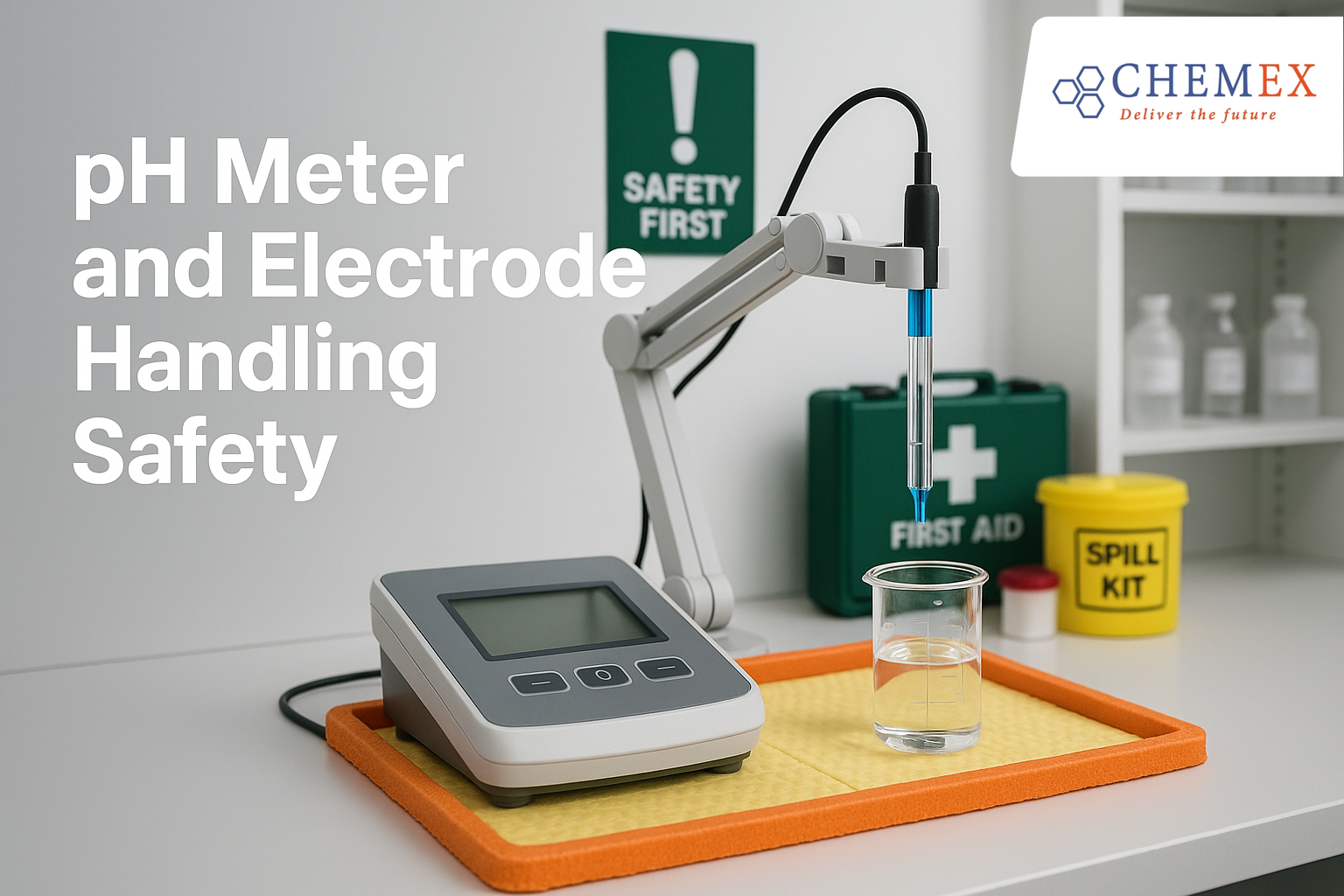
pH Meter and Electrode Handling Safety
A glass pH electrode is one of the more fragile items in routine laboratory use, and the chemicals involved in calibration, cleaning, and electrode storage carry real exposure risks. This guide covers what to prepare before problems occur, how to respond when something goes wrong, and what good maintenance practice looks like for pH meters and electrodes in Thai laboratory settings.
pH meter and electrode handling: key safety principles at a glance
Most incidents involving pH meters and electrodes are preventable with careful handling and a little preparation. When something does go wrong, having the right supplies ready and knowing your facility procedure makes the response much safer.
- Protect yourself first. Wear appropriate PPE before handling electrodes, calibration solutions, or cleaning chemicals. Do not reuse disposable gloves.
- Handle glass electrodes carefully. Avoid striking or knocking the electrode. Keep the tip away from the beaker bottom and out of the path of a magnetic stir bar.
- Store electrodes correctly. Keep the electrode in its storage buffer or storage container when not in use.
- Maintain equipment on schedule. Follow the manufacturer's recommended service intervals and keep maintenance records. Remove faulty instruments from service immediately.
- Control electrical risk in wet areas. Use properly earthed electrical supplies and keep power sources away from wet bench areas.
- Know your spill response before a spill happens. Collect cleanup supplies, define the affected area, and follow the facility's emergency procedure if breakage or a chemical release occurs.
- Segregate and label waste correctly. Classify waste by type and hazard category, and follow the waste procedure applicable to your facility.
Safe pH Meter Use and Electrode Handling During Measurement
Good habits during routine measurement prevent most of the injuries and contamination events that occur around pH meters. The two areas that deserve the most attention are how you physically handle the glass electrode and how you protect yourself from chemical exposure during the work.
Protecting the glass electrode from breakage
The glass sensing bulb at the tip of a pH electrode is genuinely fragile. The most common causes of breakage are the electrode tip touching the bottom of a beaker and a spinning magnetic stir bar making contact with the electrode. Before you start a measurement, position the electrode so the tip is clear of the beaker bottom and, if you are using a magnetic stirrer, confirm the stir bar cannot reach it.
Check the electrode attachment or carrying arm before each session. An electrode that is not properly secured can fall and shatter. When transporting glass electrodes or other glassware through a building, carry them in a sturdy cardboard box rather than by hand.
Between readings, rinse the electrode with distilled water and dry it with a clean, lint-free material. This reduces carryover contamination between samples and protects the electrode surface. When you are finished, return the electrode to its storage buffer solution or designated storage container. Leaving the sensing bulb exposed and dry shortens electrode life and increases the risk of damage. For guidance on labware suitable for pH work, see our Labware range.
Reducing chemical exposure during measurement
The chemicals used during pH measurement are not all low hazard. Calibration buffers, electrode cleaning solutions such as dilute HCl or HNO3, diluted bleach, methyl alcohol, and potassium chloride electrolyte for refilling combination electrodes all carry exposure risks that depend on concentration and contact conditions.
Wear appropriate PPE throughout, and use eye and face protection when splashes are possible. Do not reuse disposable gloves. Treat used gloves as contaminated material and dispose of them accordingly. Clean the work area after you finish, and decontaminate the bench surface to prevent residual chemicals from becoming a hazard for the next person using the space.
Always check the SDS for each chemical used in your measurement workflow. The hazard profile of your sample may also be relevant, particularly if you are measuring pH in biological, industrial, or strongly acidic or alkaline matrices.
Safe Inspection, Calibration, and Maintenance for pH Meters and Electrodes
A well-maintained pH meter gives reliable results and presents fewer safety risks. The principles behind good maintenance practice are consistent across laboratory instruments: check before use, follow a documented schedule, assign clear responsibility, and take faulty equipment out of service before anyone uses it.
Building a maintenance programme that works
Before placing an instrument into service, confirm it meets the manufacturer's specifications. After repairs, repeat those checks before returning it to use. For ongoing operation, follow the manufacturer's recommended inspection and servicing frequency. The intervals and acceptance criteria should be set by the equipment manual and your laboratory's quality system, not estimated.
A practical maintenance programme covers several interconnected elements. Keep a written maintenance plan with clearly assigned responsibilities. Train and authorize the staff who perform maintenance tasks. Maintain an equipment inventory with records of each service event, including calibration and validation results. Label instruments with the next service due date so the schedule is visible at the bench. Report faults immediately and do not return an instrument to use until corrective action is complete.
Periodic integrity checks between scheduled services help catch developing faults early. When a check reveals a problem, the instrument comes off the bench until it is repaired and re-verified.
Electrical safety in wet laboratory areas
pH meters are benchtop electronic instruments used in areas where liquids and wet surfaces are common. This combination deserves careful attention to electrical safety.
Use electrical supplies that are properly earthed and grounded. Ensure your laboratory has sufficient and stable electrical capacity for the instruments in use. Keep electrical supply points and outlets away from wet bench processes in line with local electrical safety requirements. Thai electrical installation and product standards apply to laboratory electrical infrastructure, and each laboratory room should have accessible primary switchgear such as fuses or circuit breakers to allow safe isolation for inspection, control, and maintenance.
Avoid the use of extension cords where possible. If an extension cord is unavoidable, do not use it for more than eight hours. Post visible instructions in the laboratory explaining what to do if an electrical hazard occurs, as required for workplaces covered by Thai occupational electrical safety regulations.
For the electrode itself, check for issues related to grounding or escaping current as part of routine maintenance. Disconnect the instrument from its electrical supply before performing checks that require it.
Responding Safely to Breakage, Spills, Decontamination, and Waste
When an electrode breaks or a chemical spills during pH measurement work, the immediate priority is protecting people before addressing the cleanup. Having the right supplies already in the laboratory and knowing the steps in advance makes a significant practical difference.
What to do when a glass electrode breaks
Put on appropriate PPE before approaching broken glass or a spilled liquid. Define and secure the affected area to limit access to people who are not involved in the response. Collect your cleanup supplies before you begin.
Do not pick up broken glass by hand. Use forceps, a scoop, or a dustpan to remove sharps. Cover any chemical spill with absorbent material. Apply an appropriate disinfectant over the absorbent material and allow adequate contact time as specified in your facility's procedure or the relevant SDS. After the contact time has elapsed, remove the materials, re-clean and disinfect the surface, and dispose of cleanup waste in accordance with the waste procedure for your facility.
Report the incident to your supervisor or safety officer and follow the laboratory's incident reporting procedure. Good incident records help identify patterns and prevent recurrence.
If someone may have been exposed
Where personnel may have been exposed to a chemical during a breakage or spill event, follow the applicable facility procedure and guidance for health evaluation. Refer to the current SDS for the chemical involved and contact trained assistance where needed. Do not delay seeking help while waiting for symptoms to appear.
Managing waste from pH measurement activities
Waste from pH measurement work can fall into several categories: chemical waste from spent buffers and cleaning solutions, broken glass, contaminated disposable materials, and potentially other waste types depending on the samples being measured. Each category may need to be handled differently.
Thai laboratory safety guidance recommends segregating laboratory wastes by hazard type using a defined classification scheme. As a practical example, mineral acid solutions at pH below 4 are typically classified as acid waste, and alkaline solutions at pH above 8 as alkaline waste. Wastes awaiting disposal should be clearly labelled. Hazardous waste storage areas should be access-controlled, identified with the required labels and signage, and supported by trained staff and appropriate emergency equipment.
For disposal, wastes should be sent to a waste disposal company registered with the Department of Industrial Works (DIW). The specific waste classification, storage conditions, and disposal route for your facility depend on the chemicals involved and the applicable requirements for your setting. If you work with acids, alkalis, and bases as part of your pH measurement workflow, confirm that your waste segregation and disposal arrangements reflect the hazard profile of those materials.
Before a spill happens: be ready
- Keep cleanup supplies accessible in the laboratory before they are needed.
- Know your facility's incident reporting procedure so you are not searching for it during an event.
- Confirm that waste containers are labelled, segregated by type, and stored in an access-controlled area.
- Check that electrode storage buffer and cleaning solutions have current, legible SDS documents on file.
Risk Overview and Thai Duty-of-Care Context for pH Meter Use
pH meter electrode handling safety involves a narrower set of hazards than many laboratory tasks, but those hazards are easy to underestimate. Understanding them clearly helps you build proportionate controls rather than generic ones.
The real risk picture
The most foreseeable physical hazard is electrode breakage. The glass sensing bulb is thin-walled by design, and it does not take much force to crack it. Contact with a beaker bottom, a spinning stir bar, a sharp knock during transport, or a loose electrode arm mechanism are all realistic causes. Breakage creates an immediate sharp hazard and may release electrode fill solution or expose the sample to contamination.
Chemical exposure is the second category of risk. Cleaning and maintenance workflows for pH electrodes can involve solutions including dilute hydrochloric acid, dilute nitric acid, diluted bleach, methyl alcohol, and potassium chloride electrolyte. The hazard level of each depends on concentration and the specific formulation. Treat each solution as a case requiring its own SDS review rather than assuming that dilute concentrations are safe to handle without controls. If your work involves titration reagents or volumetric solutions, see our Titration Reagents range and the related Titripur® and Titrisol® products for reference-grade calibration and analytical chemistry solutions. For pH indicator solutions used alongside pH meter calibration, the Merck pH Indicators guide covers options for precise acid-base work.
Electrical risk is present whenever a benchtop electronic instrument operates near liquids. In a wet laboratory, a faulty earth, a damaged power cord, or an electrical supply positioned too close to a wet surface can create hazardous conditions quickly.
Thai employer duties and how they apply
Thai ministerial regulations set specific duties for employers in workplaces involving hazardous chemicals. These include investigating complaints and unsafe conditions, correcting hazards promptly, and providing chemical storage areas with appropriate ventilation and measures to prevent fire causes, including those from electrical equipment and sparks.
For electrical safety, Thai occupational regulations require employers to provide suitable insulating measures and PPE for work on or near energized parts, maintain electrical equipment and wiring in safe condition, arrange inspections and maintenance by registered or licensed persons, and post visible emergency instructions and basic first-aid information for electrical hazards.
Regardless of which specific regulations apply to your setting, the practical intent behind these duties reflects sound laboratory management. Employers who investigate hazardous conditions, maintain equipment properly, and make safety information visible to staff are doing exactly what reduces incidents around equipment like pH meters. These are not just compliance measures. They are the kind of workplace habits that prevent a cracked electrode or a cleaning-solution splash from becoming a more serious event.
Frequently Asked Questions
References
- ESPReL Manual for Safety Inspection of Laboratories
- Maintenance Manual for Laboratory Equipment
- Laboratory Quality Management System: Handbook
- Ministerial Regulation on Occupational Electrical Safety B.E. 2558
- Laboratory Biosafety Manual, 4th Edition: Laboratory Design and Maintenance
- Laboratory Biosafety Manual, 4th edition
- Ministerial Regulation Prescribing Standards for Management and Operation of Occupational Safety, Health and Working Environment concerning Hazardous Chemicals B.E. 2556 (2013)
- Laboratory Biosafety Manual, 4th Edition: Outbreak Preparedness and Resilience
- Manual for Storage of Hazardous Substances (Thai edition)
Laboratory Safety and Chemical Support
Need help sourcing laboratory safety supplies, spill-control materials, or chemicals for your workflow? Contact Chemical Express Thailand for product availability and technical support.
 English
 Thai