
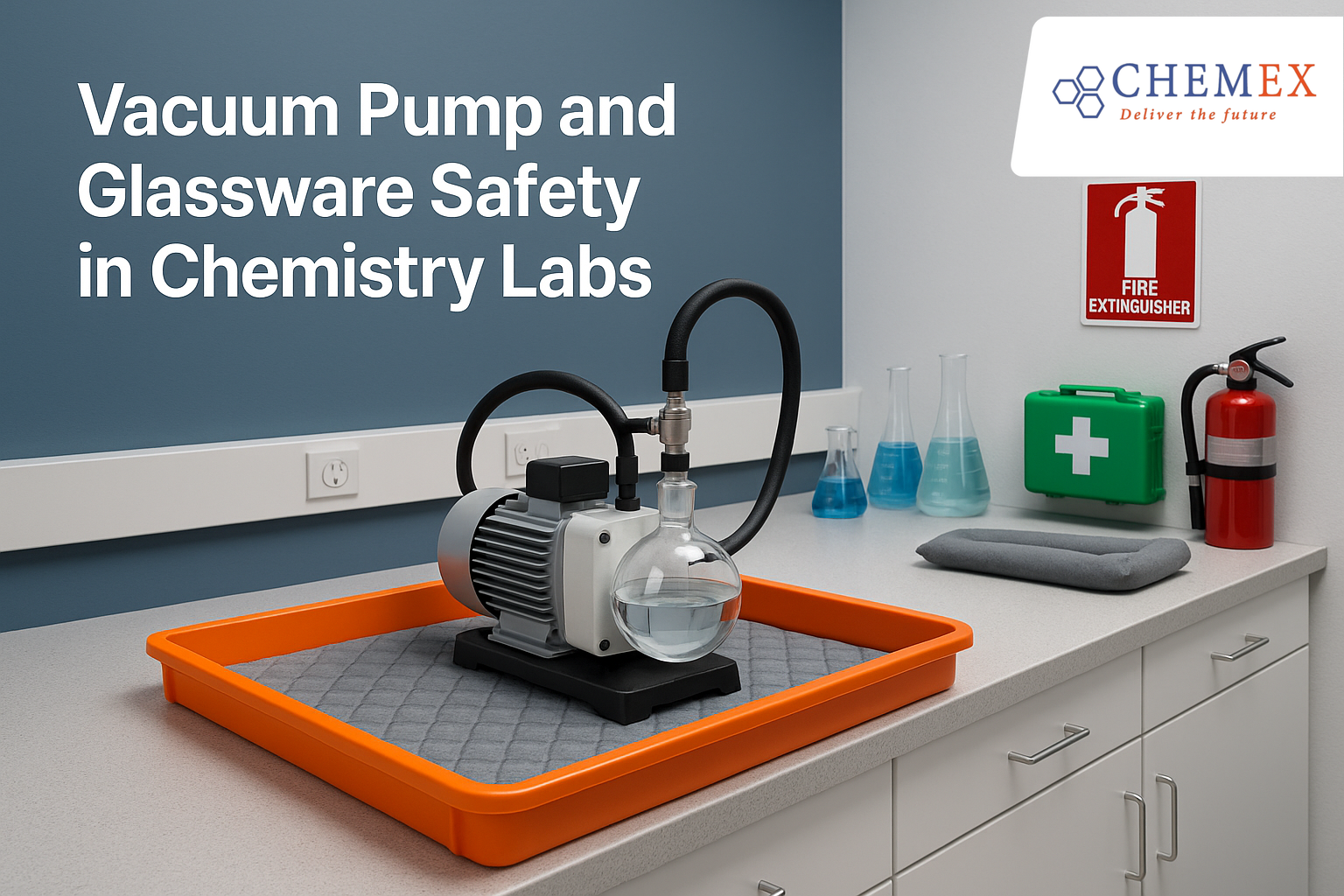
Vacuum Pump and Glassware Safety in Chemistry Labs
Vacuum systems are routine in chemistry labs, but the pressure differential they create introduces risks that are easy to underestimate. A cracked flask, an unexpected backflow, or an uncontrolled release can escalate quickly. This guide covers what to prepare before something goes wrong, how to respond when it does, and what to think about afterward.
Vacuum pump and glassware incidents: where to focus first
When a vacuum system or glassware failure occurs, protecting people comes before cleanup. Follow these priorities.
- Evacuate if needed. If gas, vapour, aerosol, or powder has been released, remove personnel from the area and restrict access until the situation is assessed.
- Protect yourself before re-entering. Put on appropriate PPE before approaching the incident area.
- Address any exposure immediately. Flush exposed eyes or skin with water promptly, following the guidance in the current SDS.
- Handle broken glass carefully. Use forceps or a scoop rather than bare hands when collecting glass fragments.
- Contain any spilled material. Use appropriate absorbents to contain and remove liquids, following the chemical-specific SDS and facility procedure.
- Notify the responsible person. Report the incident to your supervisor or safety officer and follow your facility's reporting procedure.
Safe operation, maintenance, and emergency response for vacuum pumps and evacuated glassware in chemistry labs
Good vacuum pump and glassware safety starts with consistent operating habits and a clear response plan before anything goes wrong. Preparation is far easier to manage before an incident than during one.
Before you begin: safe-work basics
Performing a risk assessment before each operation is one of the most practical steps you can take. Identify what chemicals are involved, how they can cause harm, and whether the operating conditions change the hazard level. This gives everyone working on the procedure a shared understanding of what to watch for.
General lab rules apply directly to vacuum work: wear appropriate PPE including eye and face protection, hand protection, and suitable clothing. Keep hair tied back, wear closed-toe shoes, and avoid eating, drinking, or applying cosmetics in the lab. Where vapours, gases, or aerosols may be released, work inside a chemical fume hood to limit inhalation exposure. Avoid working alone on procedures that could result in injury or sudden exposure.
Restricting access to the immediate work area is also worth building into your routine. Keeping non-essential personnel away means fewer people are at risk if something does go wrong.
Selecting the right glassware for vacuum service
Standard glassware is not designed to handle the internal stress created by vacuum. Using vacuum-rated glassware instead of standard glassware reduces the risk of implosion, which can scatter glass fragments and release contents without warning. For vacuum filtration work, heavy-walled filtering flasks are preferred over thin-walled alternatives. PVC-coated glass filtering flasks or Nalgene filtering flasks offer an additional layer of protection by helping to contain fragments if a failure does occur. If you are sourcing uncoated glass filtering flasks, check that they meet the relevant product standard referenced in the manufacturer's literature.
For broader labware selection that suits vacuum applications, review what is available through our labware range to find options suited to your procedures.
If an incident occurs: immediate response principles
When a glassware failure or vacuum pump incident releases material, the first priority is personnel safety. If the release involves gas, vapour, aerosol, or powder, evacuate the immediate area and restrict access. This limits the number of people who could be exposed while the situation is being assessed.
Once you have appropriate PPE on, address any spilled liquid by using absorbent materials to contain and remove it. The specific absorbent and method depend on the chemical involved, so follow the current SDS and your facility emergency procedure rather than applying a single approach to every situation.
Broken glass should be collected using forceps or a scoop, not by hand. Dispose of cleanup materials according to the procedure and requirements applicable to your facility and the waste involved.
If someone may have been exposed
For skin or eye contact, flush with copious water using an eyewash or safety shower. For corrosive materials, continuous eye irrigation is particularly important. The SDS for the chemical involved will specify the appropriate first-aid response and should be consulted immediately. Where there is uncertainty about the exposure or the person's condition, seek trained assistance rather than relying on first aid alone.
After the incident
Once the immediate response is complete, notify your supervisor or safety officer and follow your facility's reporting procedure. Documenting what happened, what was done, and what was found is a routine part of managing incidents responsibly. Review what the incident reveals about your current procedure and whether any changes are needed before resuming work.
Hazard recognition and risk assessment for vacuum pumps and evacuated glassware in chemistry labs
Understanding what can go wrong with vacuum equipment helps you design better controls before an incident occurs. The hazards in vacuum work overlap significantly with general laboratory chemical hazards, but the pressure differential adds a specific failure mode that is worth thinking through carefully.
What can cause harm
Glass failure is one of the more immediate physical hazards. When evacuated glassware fails, the implosion and resulting fragments can cause lacerations, and any contained material is released at the same time. Chemical exposure through inhalation, skin contact, or eye contact can follow a release from either the glassware or the pump system. Where flammable liquids or vapours are involved, the presence of inappropriate electrical equipment or other ignition sources adds a fire and explosion dimension. Electrical shock from laboratory instruments is a separate concern that applies to pump equipment as it does to other powered lab devices.
For vacuum filtration procedures, the filtration equipment and associated connections you use are part of the hazard picture. Weak connections, unsuitable tubing, or improperly seated joints can lead to sudden pressure changes or line failures.
How to assess the risk
A structured risk assessment for vacuum operations starts by identifying the chemical hazards and the ways they can cause harm: inhalation, skin or eye contact, ingestion, or fire and explosion. From there, consider the quantities involved, the operating conditions, and the specific tasks, including maintenance and cleaning where some controls may not be in place. Think about whether the hazard increases under particular conditions, such as elevated temperature or pressure, and what happens if a control measure fails.
A straightforward likelihood-versus-consequence evaluation helps prioritise where controls are needed most. Rate the likelihood of each harm scenario (for example, unlikely, possible, or likely) and the consequence (for example, negligible, moderate, or severe). Where the combination of likelihood and consequence is unacceptable, identify additional controls. Review the assessment whenever procedures change or an incident suggests the original assessment may no longer reflect the actual situation.
For chemical-specific hazard information relevant to your procedure, refer to the current SDS for each substance involved. If you work with analytical reagents, ensure the SDS reflects the grade and concentration you are using, since hazard profiles can differ between reagent grades.
Engineering controls, selection, and setup for laboratory vacuum systems
The right engineering controls reduce the likelihood of failures reaching people. For vacuum systems, this means both choosing suitable components and configuring the system so that failures are contained rather than propagated.
Glassware and component selection
As noted above, vacuum-rated glassware is the appropriate starting point for any evacuated system. For filtering applications, heavy-walled flasks are preferred, and coated alternatives help contain fragments if the glassware fails. Check the manufacturer's product information and relevant standards before specifying glassware for vacuum service. The same care should apply to connections, tubing, and fittings: consult the equipment manual and, where uncertain, seek guidance from a qualified person.
Preventing backflow and uncontrolled releases
Backflow prevention is a key engineering consideration for vacuum systems. Installing backflow prevention mechanisms, including deep-seal syphons where applicable, helps stop liquids, aerosols, or vapours from moving back upstream through the system. Anti-backflow valves in ducting can prevent reversal of airflow back into the laboratory or containment device.
Where exhaust or drainage may carry hazardous vapours or aerosols, appropriate filtration before release and decontamination of liquid effluents before discharge are important principles to build into the system design. The specific filtration approach, routing, and discharge arrangement should reflect the chemicals involved, the pump type, and the requirements applicable to your facility. Consult your facility's engineering and safety team when designing or modifying a vacuum system, rather than applying a single fixed configuration across different situations.
Quick tips for vacuum system setup
- Select glassware rated for vacuum service; never use standard glassware as a substitute.
- For filtering applications, prefer heavy-walled or coated flasks that limit fragment dispersal if failure occurs.
- Build backflow prevention into the system at the design stage rather than adding it after problems arise.
- Consult equipment manuals for the specific pump and glassware models in use; general specifications do not substitute for model-specific guidance.
- Where the system involves hazardous exhaust or effluent, involve your facility's engineering and safety team in the design or modification decision.
Records and maintenance
Keeping maintenance information for equipment and instruments, along with user manuals and standard operating procedures, is a recognised part of laboratory safety management in Thai research settings. Good records mean you can confirm that equipment has been serviced, that any faults were identified and addressed, and that the people using the equipment have been trained. When an incident occurs, this documentation also helps establish what the system condition was before the event.
What specific records your facility needs to keep, and how they should be maintained, will depend on the nature of your laboratory, the equipment involved, and the requirements applicable to your setting. Review your facility's existing documentation practices and identify any gaps.
Thailand compliance context and safety management expectations in chemistry labs
Thai occupational safety and health regulations include requirements covering machinery safety, fire prevention, hazardous chemicals, and electrical work, each phrased as employer obligations. The responsible safety person in any workplace is expected to identify which regulations and sections apply to their specific setting. For laboratories with ventilation and air-conditioning systems, relevant ministerial regulations and engineering standards for installation and maintenance also apply.
The ESPReL safety inspection framework, developed for Thai research laboratories through the National Research Council of Thailand, sets out documentation expectations as part of routine safety management. These include records of personnel qualifications and training history, laboratory assessment and audit documents, accident reports, and maintenance information for physical infrastructure, equipment, and instruments, as well as equipment user manuals and standard operating procedures. Treating this documentation set as a baseline for any well-managed laboratory is a practical starting point, regardless of whether a formal legal obligation is in place for your specific setting.
How to determine what applies to your lab
The practical approach is to work through a systematic identification of which occupational safety and health laws and sections are relevant to your workplace. Thailand Institute of Occupational Safety and Health guidance supports exactly this process: a responsible safety person is expected to review applicable regulations and confirm which clauses create obligations for their employer. If your laboratory is part of a larger institution or industrial facility, the compliance requirements may be set at that level and may already define what documentation, training, inspection, and maintenance records are required.
For chemistry products used in your laboratory, the SDS is a starting point for understanding the hazard profile and the general handling expectations. It does not substitute for a full regulatory review of your facility's obligations, but it provides practical information you can use immediately when setting up controls or responding to an incident.
Building a safety management system around clear documentation, regular review, and trained personnel gives any laboratory a practical foundation, whether the primary driver is a formal legal requirement or a professional commitment to safe operations. The most useful action is to confirm what currently applies to your setting, close any gaps in records or training, and make sure your emergency response procedure reflects the actual equipment and chemicals in use.
Frequently Asked Questions
References
- Safety in the Use of Chemicals at Work: An ILO Code of Practice
- ESPReL Manual for Safety Inspection of Laboratories
- Laboratory Biosafety Manual, 4th Edition: Laboratory Design and Maintenance
- Safe Management of Wastes from Health-Care Activities, 2nd edition
- Manual and Checklist for Identification of Applicable Occupational Safety and Health Laws
- Laboratory Quality Management System: Handbook
- Working Safely with Vacuum | Duke OESO
- Biological Safety Cabinets and Other Primary Containment Devices
- Risk Assessment (Laboratory Biosafety Manual monograph)
Laboratory Safety and Chemical Support
Need help sourcing laboratory safety supplies, spill-control materials, or chemicals for your workflow? Contact Chemical Express Thailand for product availability and technical support.
 English
 Thai